No one design will fit all applications. This week’s article reviews the three methods used to measure consistency across the various pulp and paper processes. These processes include, among others, stock prep, mixing chests, machine chests, broke processes, white water, broken thickeners, filtrate, couch pit, and so forth. The point is throughout our P&P process, consistency transmitters are vitally essential to understanding and controlling our processes. Occasionally, a particular style of consistency meter was chosen and, unfortunately, did not work. Don’t despair; this can happen due to not fully understanding what ‘trash’ is within the pipes transmitting the pulp slurry.
As noted below, there are three very different designs for consistency meters: Shear Force Static Blade, Microwave, and Optical Reflective. If one style was chosen, but issues arose (e.g., metals from recycled debris, wet strength stringers, excessive fluctuations in consistency), then review what caused the problem and start fresh. However, these issues can be avoided with prudent discussions with your instrument provider or Pulmac’s in-house expert, Pat Dixon.
Consistency (or Percent Solids) Meters
 To manufacture a consistent, quality product, be it in the pulp mill, deinking, board, tissue, linerboard, communication papers, bleach plant, or kraft mill, reliable consistency readings are critical.
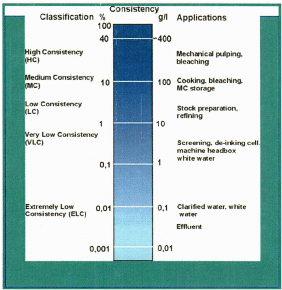
They can significantly impact operating rates, efficiencies, and variability at each process step. Most consistency meters measure from a very low level of 0.1% solids (e.g., mostly water with a small amount of fiber, etc.) up to 16% solids (e.g., very thick pulp slurry.)
Another way to think about consistency is the percentage of solids in the fluid being measured. From a critical driver standpoint, controlling the consistency helps improve the bottom line by reducing fiber usage, optimizing fiber-blending ratios, reducing energy usage, reducing chemical usage, and enhancing process stability.
Overall, consistency meter projects have roughly a 30% IRR.
Method 1: Shear Force Consistency Transmitters
 This is the oldest and most widely used technology to measure consistencies. Dating back roughly 50 years, this technology uses a sensor in the middle of the process flow to sense and measure the shear forces as the product flows around the detection unit. In addition, it measures the relative velocity between the sensor and fibers. To achieve suitable sensitivities for the product being measured, both an appropriate choice in the sensing unit and calibration are required to achieve repeatable results. This technology is insensitive to color and chemicals, but sudden flow or grade changes can cause calibration issues.
Further, debris or items such as stringers from wet strength in towels can hang up on the sensing unit and affect performance. Several designs, including an ‘active’ sensing blade, a ‘static’ sensing blade, and a ‘rotary’ sensing transmitter, each with their features, benefits, and costs. Consistency measurements can go from a low of 1.5% to a high of 16%, depending on the type of sensing element is chosen. Past performance feedback shows that rotary consistency transmitters have performed well in the brown stock area and pulp mills.
Shear force-style instruments are available from ABB, Andritz, BTG (a Voith Company), and Valmet.
Method 2: Microwave Consistency Transmitters
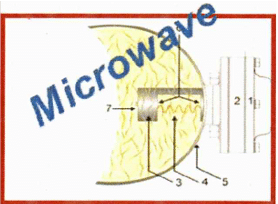 Introduced approximately 40 years ago, this uses a microwave beam and receiver to send and receive information to measure total consistency for fiber, fines, and ash. This technology is independent of the fiber length, wood species, freeness, or blend present in the process stream. Though considered very accurate and reliable, these units are affected by conductivity (e.g., no metals, trash from recycling), temperature swings, and entrained air/ pressure.
The typical consistency range is 0% – 8% and has no moving parts. Based on performance feedback, microwave consistency meters with flush electrodes work well. Still, they are limited to a 12″ pipe and require a workaround on entrained air by increasing line pressure to around 20 psig.
Microwave consistency meters are available from BTG (Voith), Andritz, and Valmet.
Method 3: Optical Consistency Transmitters
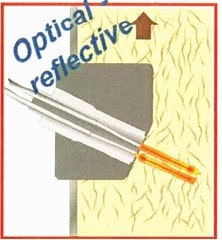 Optical consistency transmitters were introduced about 30 years ago. The newer optical transmitters (roughly 25 years ago) use near-infrared light (NIR) to measure consistency. Like blade consistency meters, there are several optical designs.
One optical design is used for very low consistency readings (range 0.01% to 3%) that uses a gap where a NIR light is transmitted from one side and received on the other, similar in concept to the microwave send-receive setup. Typical applications are for screens, cyclones, deinking cells, effluents, trays, head boxes, etc., requiring a minimum flow rate of 4.3 fps.
The second design operated by having NIR light reflected off the material and bounced back to a detector for analysis. Again, this is for the more traditional consistency ranges of 0.5% to 16%. Both methods require a minimum flow velocity of 4.3 fps and are virtually insensitive to vibration, temperature, fiber type, fillers, flows, color, etc.
Some optical consistency meters can measure total consistency and ash independently. In addition, optical consistency transmitters have no moving parts, are low maintenance, and are easy to calibrate.
BTG (Voith) is the largest supplier of optical consistency meters, followed by Satron, Cerlic, and Valmet.
Conclusion
In summary, no one technology fits all situations. In reviewing the past performance of 30 standalone consistency meter projects in pulping, bleaching, and paper machines, the key economic drivers on these investments are listed in the order of benefits received:
- Reducing fiber usage
- Optimizing fiber-blending ratios
- Reducing energy usage
- Reducing chemical usage and
- Improving process stability
Pulmac Team Can Help Increase Your IRR
Overall, these standalone consistency meter projects had an average of 33% IRR. Recommend consulting with your internal SME on your application or calling my colleague at Pulmac, Pat Dixon, pdixon@pulmac.com, (512) 771-3936 to review your specific needs.